
Nepal’s Flash Flood Disaster: When a Warming Himalaya Sends a Warning
Nepal has once again been reminded of a painful truth: when nature strikes with full force, human strength, technology and infrastructure can suddenly appear very small.
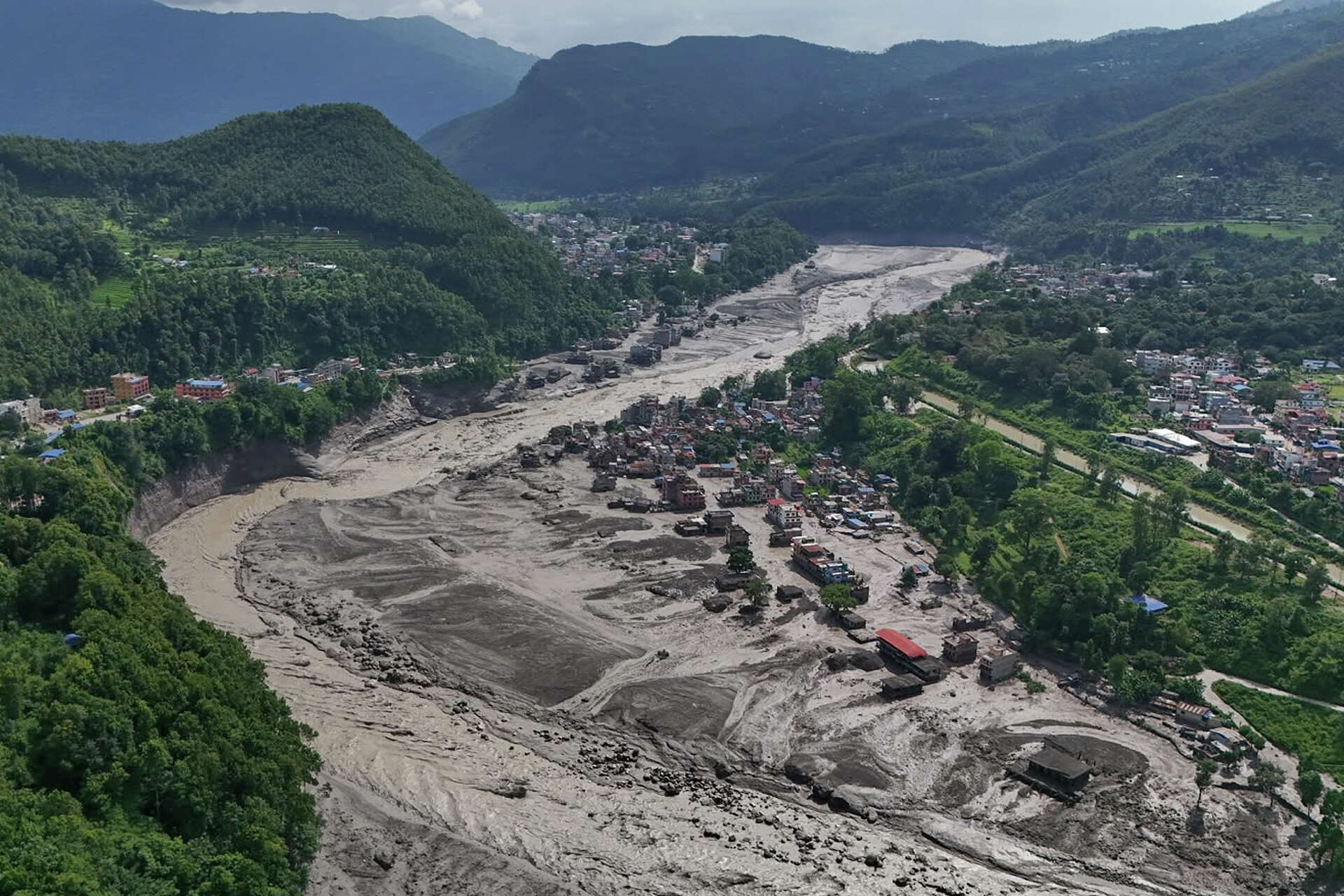
The devastating flash flood that swept through the Bhotekoshi river system in Rasuwa on August 26 is not simply another seasonal flood story. It is a warning from a rapidly changing Himalayan environment. The disaster has killed scores of people, left hundreds reported missing or out of contact, and destroyed settlements, roads, bridges, hydropower infrastructure and livelihoods. The full scale of the tragedy is still emerging, and casualty figures have changed rapidly as rescue operations continue.
More importantly, preliminary scientific evidence suggests that this was not an ordinary monsoon flood.
Officials from Nepal’s Department of Hydrology and Meteorology say satellite imagery indicates that an ice avalanche and landslide may have blocked a river upstream, creating a temporary lake of water, ice and debris. When that natural dam failed, the accumulated mass rushed downstream with extraordinary destructive force. Authorities have stressed that the exact mechanism is still under investigation. Significantly, there was no heavy rainfall in the affected area immediately before the disaster, strengthening attention on a cryosphere-related trigger rather than conventional monsoon flooding.
Reuters reported that satellite images showed a substantial section of glacier collapsing from around 5,200 metres and falling more than 1,200 metres into the valley below. Scientists are examining whether an earthquake, unstable ice and rock, unusually warm conditions, or a combination of these factors triggered the collapse.
That distinction matters. Nepal is accustomed to floods caused by intense monsoon rainfall. But the emerging Himalayan danger is more complex: melting glaciers, expanding glacial lakes, unstable slopes, ice and rock avalanches, landslides, temporary natural dams and sudden outburst floods can interact in a chain reaction. A disaster can begin high above inhabited valleys and reach communities downstream before people have enough time to understand what is happening.
A Himalayan Crisis Larger Than Nepal
The tragedy must therefore be examined within the wider context of climate change and global warming.
The Hindu Kush Himalaya is undergoing profound transformation. ICIMOD’s 2026 Glacier Outlook reports that glaciers across the region are rapidly shrinking and that glacier mass loss has accelerated significantly since 2000. Around 89 percent of the observed years covered by long-term measurements showed negative glacier mass balance. The consequences extend beyond disappearing ice: glacier retreat changes river systems, contributes to the formation and expansion of glacial lakes and increases the potential for glacial lake outburst floods.
Scientific research published this year similarly warns that rapid warming across the Himalaya-Karakoram is driving glacier retreat and the expansion of glacial lakes. Ice avalanches and extreme precipitation are among the major triggers identified for glacial lake outburst floods.
Nepal has already received repeated warnings.
The catastrophic 2024 flood in Thame in the Everest region was caused by a complex chain reaction in which a rock avalanche struck a glacial lake, generating a displacement wave that breached the lake. ICIMOD says more than 90 glacial lake outburst floods have occurred in Nepal since the early twentieth century, while rapid warming and glacier retreat are creating additional risks across the Hindu Kush Himalayan region.
The Bhotekoshi itself experienced another major flood in July 2025, which Nepal’s Department of Hydrology and Meteorology later linked to the outburst of a glacial lake near the Nepal-China border. Now, little more than a year later, the same river system has again produced catastrophe.
These events can no longer be dismissed individually as isolated natural accidents.
Climate Change Does Not Create Every Disaster, but It Changes the Risk
Scientific caution is essential. It would be premature to declare that global warming directly “caused” this particular avalanche or flood before detailed investigation is completed. Earthquakes, geology, slope instability and other natural processes can also trigger avalanches and floods.
But climate change is altering the environment in which these events occur.
As temperatures rise, glaciers lose mass, permafrost and frozen slopes can become less stable, new lakes form behind ice or loose moraine, existing lakes expand, and large quantities of rock and sediment become exposed. An avalanche entering a lake or river can then produce a cascading disaster far downstream.
Nepal’s own 2026 climate assessment concludes that global warming has already increased the frequency and intensity of high-impact climate extremes in the country, increasing risks to communities, infrastructure and ecosystems.
This is why the Rasuwa tragedy must be understood not only as a disaster-management issue, but also as a climate-security issue.
Nepal Bears a Cost It Did Little to Create
There is also a question of global climate justice.
Nepal’s historical contribution to global greenhouse-gas emissions is tiny compared with that of the major industrial economies. Yet Nepal stands on the front line of the consequences. Its glaciers, mountains, river valleys, settlements, agriculture, tourism infrastructure and hydropower projects are directly exposed to a warming climate.
For Himalayan countries, climate change is therefore not an abstract debate about temperatures several decades into the future. It is about whether a glacier above a village remains stable. It is about whether a glacial lake suddenly bursts. It is about whether a bridge survives, whether a hydropower project remains standing, whether tourists return safely from a trekking route and whether families living beside rivers receive enough warning to escape.
Countries that contributed least to the climate crisis should not be left alone to finance the consequences.
Nepal must make this argument forcefully in international climate negotiations. Climate finance should not be limited to long-term mitigation projects. Vulnerable mountain nations need resources for adaptation, glacier monitoring, disaster preparedness, early-warning systems, resilient infrastructure and compensation for climate-related loss and damage.
Nepal Must Also Examine Its Own Choices
Climate change, however, cannot become an excuse for every failure inside Nepal.
We must also ask uncomfortable questions about how roads are constructed, where settlements are permitted, how hydropower projects are approved, how rivers are encroached upon and whether environmental assessments genuinely influence development decisions.
A fragile mountain cannot be treated like an unlimited construction site.
Roads carved recklessly into unstable slopes, extraction of river materials, poorly planned settlements along flood corridors and infrastructure built without adequate geological and hydrological assessment can turn a natural hazard into a human catastrophe.
We cannot stop an avalanche. We cannot prevent every earthquake. We cannot command a glacier not to melt. But we can decide where we build houses, bridges, highways and hydropower projects. We can determine how closely dangerous glaciers and lakes are monitored. And we can decide whether warnings reach downstream communities within minutes rather than after disaster has already arrived.
Early Warning Must Cross National Borders
The latest disaster also demonstrates that Himalayan disaster management cannot stop at political boundaries.
Rivers, glaciers, avalanches and climate systems do not carry passports. Many rivers entering Nepal originate in or are influenced by terrain across the Tibetan Plateau. Information from upstream can therefore be a matter of life and death downstream.
Following the Bhotekoshi disaster, Nepal and China agreed to strengthen the exchange of meteorological and hazard information. This cooperation should become permanent, automatic and technically integrated rather than dependent on communication after an emergency has begun.
Nepal needs real-time satellite monitoring of potentially dangerous glaciers and glacial lakes, automatic river gauges, seismic and slope monitoring, community sirens, mobile-phone alerts and clearly mapped evacuation routes. Communities living along vulnerable river systems should know beforehand where to run when an alarm sounds.
Thirty minutes of reliable warning can mean the difference between a disaster and a mass casualty event.
The Himalaya Is Sending Us a Message
The latest Bhotekoshi tragedy should not disappear from national attention once rescue teams leave and headlines change.
Nepal is a country created by the extraordinary geography of the Himalaya, hills and plains. That geography gives us water, tourism, biodiversity, agriculture, culture and identity. But under a rapidly warming climate, the same landscape is becoming increasingly unpredictable.
The lesson is therefore neither that humanity can defeat nature nor that we are helpless before it.
The lesson is that we must learn to live more intelligently within its limits.
Nepal must invest in science, glacier research, early-warning systems, climate-resilient infrastructure and responsible land-use planning. At the same time, major emitting countries must recognize that Himalayan nations are already paying a price for a climate crisis they contributed comparatively little to creating.
The waters rushing down the Bhotekoshi carry more than rocks, ice and debris. They carry a warning.
If governments continue to treat glacier retreat, global warming, avalanches and extreme floods as separate problems, disasters like this may become increasingly familiar. The Himalaya is changing before our eyes.
The question now is whether our policies, development practices and global climate responsibilities will change quickly enough with it.


United Sherpa Association Transfers $30,521 to Nepal’s Prime Minister’s Disaster Relief Fund
3 days ago
Global Sherpa Conference 2026: A Global Gathering to Preserve Heritage, Identity and Unity
1 week ago